Fostering - An investment that
paid
major dividends.
by Rick Snyder,
GSR-SP volunteer & foster
dad
Our
family had been in contact
with GSR-SP for years, first
adopting a
German Shepherd through them,
then volunteering at events, and
then
adopting another. We wanted to
do more, though, and after
hearing about
a shortage of foster homes, we
decided that this was an
important way
we could help the organization.
It seemed so painfully unjust,
to think
of the clock relentlessly
ticking away on a good dog in a
crowded
shelter with nowhere to go, and
we wanted to help.
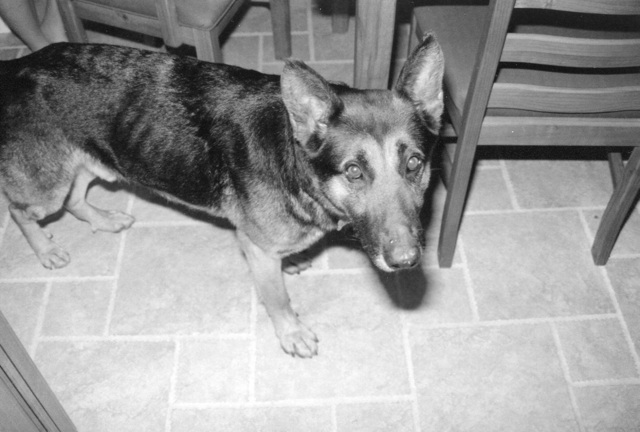
Major,
showing
some ribs when
we first brought him home
from the shelter.
We
also knew it would be a
serious
undertaking, with time
spent training and
evaluating and getting
used
to another dog in the
mix at home. Still, when
word came that there was
a dog to be fostered, we
were nervous and excited
to give this thing a
try.
Major
was a male German
Shepherd
dog, anywhere from 3-5
years of age,
who was at a shelter in
central PA. He had been
evaluated there by a
volunteer, who through
experience had
determined that he was a
good dog
who'd just had some
tough breaks.
Major had been a yard
dog. He'd spent his 3-5
years on a concrete pad,
chained to a doghouse,
in someone's backyard.
When the person moved,
they left Major behind.
A neighbor eventually
noticed he was
unattended, and called
the SPCA.
Major was skinny.
He had rope
burns around his neck.
His hind legs were
under-developed from
lack of exercise. He had
some pressure sores from
the concrete pad.
We drove out to see him,
figuring that if he got
along with our other
Shepherd, Maggie, we'd
take him on. We brought
Maggie along, thinking
we'd get them to
interact a bit and see
how it went.
When we arrived at the
shelter, we found that
the staff had brought
him
into the main lobby
area, and put him in
their greeting enclosure
there. Major was being
what we call a popcorn
dog, in that he was
bouncing up and down
like popcorn in a pan,
and barking his fool
head
off at the prospect of
someone coming to pay
him some attention. His
head would appear and
dissappear and reappear,
up and down and up and
down, bark bark bark
bark bark.
We managed to put a
lead on him,
and took him to the
shelter's grassy
patio area, where you
could go to get a look
at the dogs and walk
them
around. Major sniffed
around the grass, peed
on a bush, and sniffed
at
us and at Maggie. He
seemed friendly enough.
Maggie was nervous and
excited to meet him, but
when he tried to mount
her she let him have
some bared teeth and a
big snarl, and we pulled
them apart. When we let
them back together
again, Major was more
subdued. In all the time
we
had him, he never did
that again. We gave them
some more time together,
saw that they had sorted
out their first doggie
issue well enough, went
back inside and filled
out the paperwork and
gave them the check.
Major
was now our
responsibility.
In one way, we were
lucky. With Major, we
knew what his story was,
where he had lived and
what he had been
through. A lot of dogs
come to
us with very little
information, or none at
all. In another way,
Major
was a very challenging
dog. He was essentially
a gigantic overgrown
puppy, with no house
training and no
socialization of any
kind.
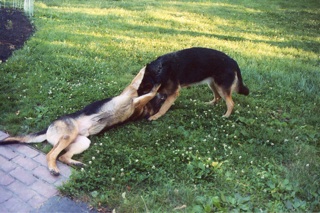
Maggie
schooling Major on how
to play like a
dog.
Things
Major
did included
climbing over the
sofa and into the
big picture
window, knocking
over plant pots and
spilling dirt all
over, so he
could stand and lean
against the front
windows and greet us
when we
came up the walk. We
temporarily
relocated the
plants, and told him
not
to do that.
He lifted his leg in
the house. Once. He
got the spray bottle
for that,
and a sharp no.
He chased our old
cat. Once. We tugged
his leash and told
him no.
We took him to the
vet, and he behaved
himself just fine.
And so on, and so
on. We tried to be
firm but kind,
because we
remembered he'd
never been in a
house, maybe had
never been let near
a
cat, and he couldn't
know right from
wrong until we
taught him.
And Major was a
quick learner.
Pretty much tell him
once, and he got it.
Things Major
did not do included
playing. You could
throw a ball or a
frisbee, and he'd
look at it. Maggie
would come up and
give him her
"Let's play" bow,
and he'd just look
at her, and then
look at us for
direction. We never
really got him to
play with toys or
fetch us
anything, but Maggie
refused to give up
on the playing, and
pestered
and rassled and
chewed on him enough
that he finally
started getting
the hang of it.
We let him settle in
for a few weeks, and
get comfortable
enough to
show us his true
colors. The
volunteer had been
right. Good dog, bad
breaks. Now he was
getting along with
us, with strangers,
with other
dogs, and he was
leaving the cats
alone. No messing in
the house, no
fighting over food,
no big problems.
So after a month, we
talked it over with
our rescue friends,
and they
put him up on the
website.
There was very
little interest in
Major.
In a shelter, with
limited capacity,
overworked staff and
no one to
teach him, that
would have spelled
disaster. In our
home, Major was
just passing the
time, hanging out,
learning how to
leash walk and race
around the yard.
A couple months went
by. We'd just about
come to the
conclusion that
Major was a
permanent addition
to our home, when we
were told there was
someone who might be
interested in
adopting him. We got
the contact
information, and did
the proper
introductions. Major
behaved just fine
with the other dogs
in his prospective
home, and enjoyed
having
attention lavished
on him by his
potential new
parents. He ended up
being adopted by a
wonderful family,
and lived happily
ever after.
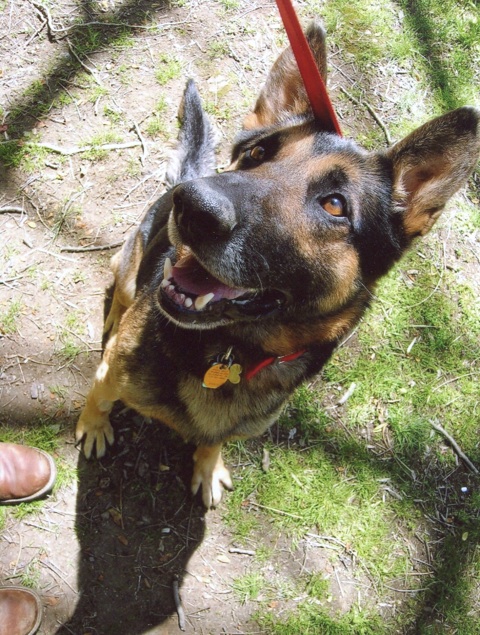
Major,
being
such a good boy.
We
know,
because we
still go to
visit him
every now and
then. I'm not
sure if he
still
remembers us,
or
his hard life
before we took
him in. But if
there's any
place on earth
that's the
exact opposite
of a doghouse
on a concrete
pad, this
place
is it; Major's
forever home
is wonderful,
and he's got
it really
good.
He's not our
dog. We didn't
even have him
for that long.
But I'm so
happy we were
there for him
when he needed
to catch a
break. And to
know that all
the work we
put in, to try
and set him up
as best we
could to be a
good dog for
someone else,
paid off so
well.
.
The
Foster
Agreement ~
View
|